Executive Summary
LanTV turns television reception into a network service, allowing organizations to distribute large numbers of channels through existing IP infrastructure instead of deploying separate receivers and cabling at every location. Its ability to ingest hundreds of channels creates a corresponding requirement for storage when organizations need continuous recording, monitoring, replay, or long-term archiving.
Xendure provides the high-capacity storage layer needed to retain this growing volume of video while supporting sustained writes, scalable capacity, and reliable access. Integrating LanTV and Xendure within one technology group also simplifies architectural alignment between content acquisition and storage infrastructure, reducing the complexity of coordinating separate platforms. For large deployments, storage architecture should be designed around channel count, recording quality, retention duration, access patterns, protection, and future growth rather than today’s capacity alone. A distributed Xendure environment provides a scalable foundation in which capacity expands with demand while recorded television remains available. across extended retention periods.
LanTV: Solution, Use Cases, and Customers
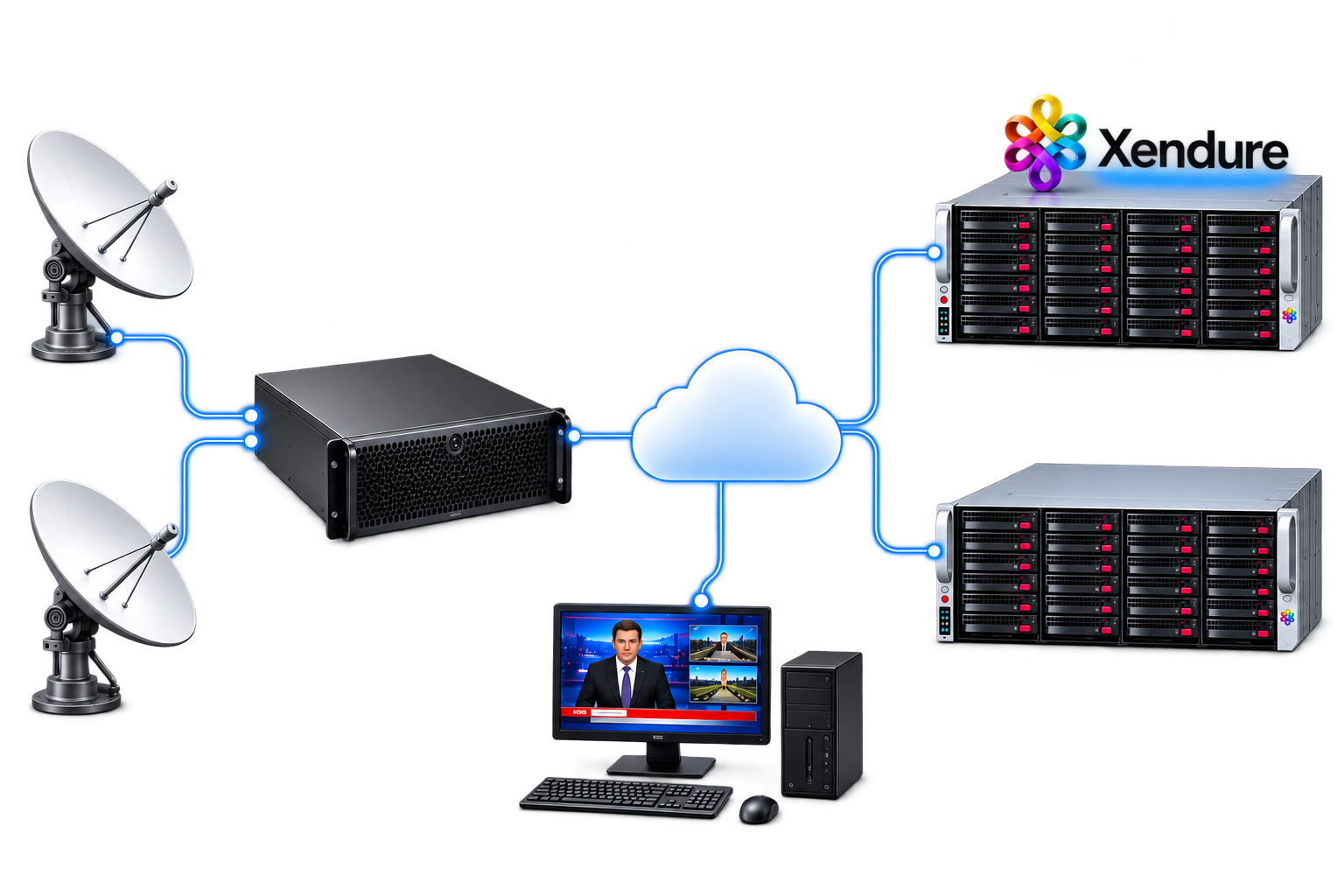
LanTV turns television into a network service. In this architecture, the LanTV server connects on one side to TV sources such as terrestrial antennas and satellite reception equipment and, on the other, publishes the received signals across the IP network. This allows an organization to use its existing network infrastructure to distribute and access TV content instead of deploying a separate TV, receiver, cable run, and dedicated hardware at every location.

One of LanTV’s key capabilities is ingesting a large number of channels through multiple inputs. A 28-input system can receive and stream more than 400 TV channels across the network. The solution also supports user access control, multi-channel viewing, centralized management, and software-based video walls.
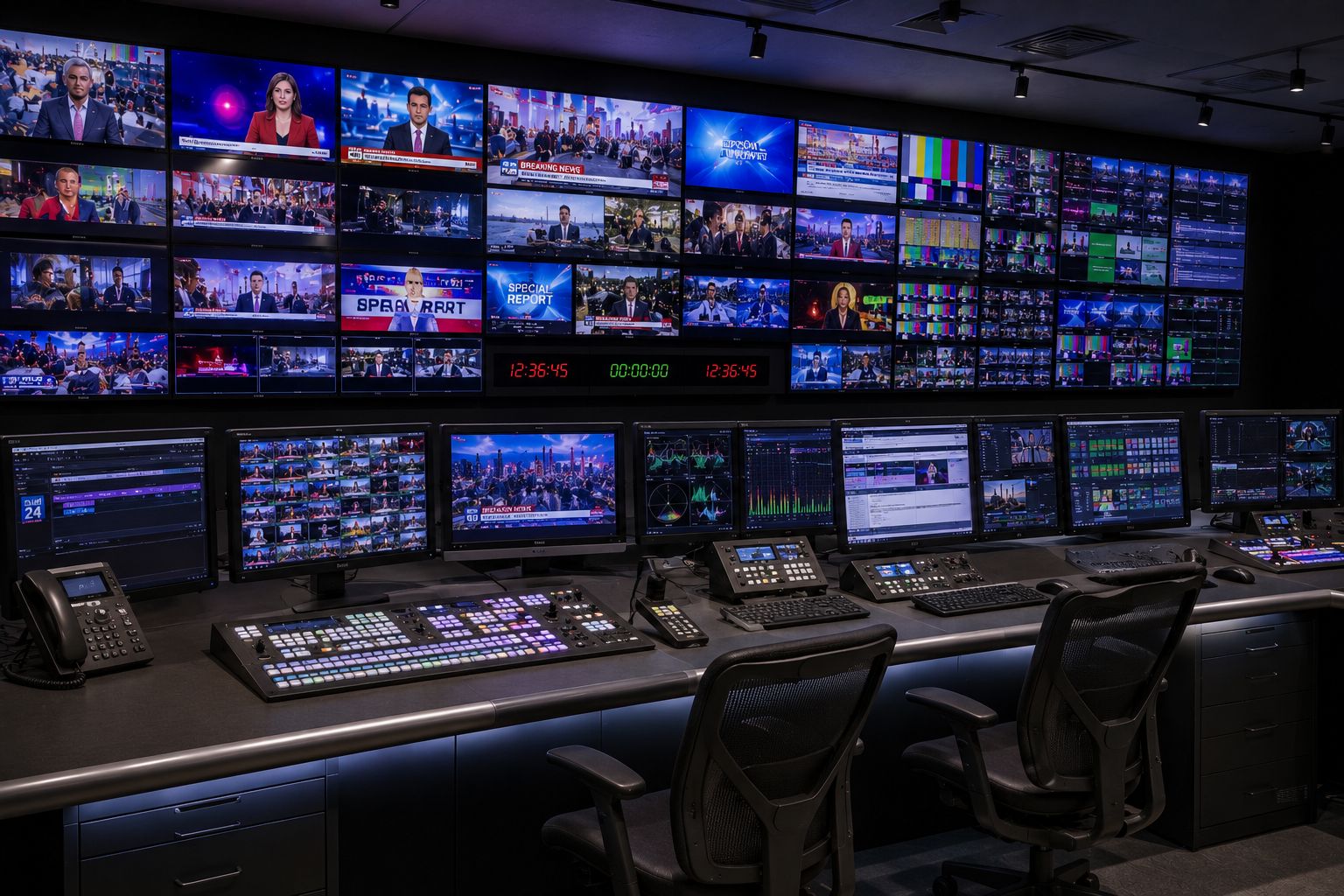
LanTV is used to build modern centralized TV distribution systems in organizations and large buildings, monitor TV networks, support news and media operations, monitor large numbers of channels, and centrally record TV programming for later access by users.
For centralized recording, LanTV can record dozens of programs concurrently according to predefined schedules. Recording is no longer dependent on a user being present when a program airs, and recorded content can be made available to users over the network. This turns LanTV from a TV distribution solution into an important component of the organization’s video ingest and archive workflow.
LanTV’s High-Capacity Storage Requirement and the Role of Xendure
As channel counts and retention periods increase, storage becomes one of the most important components of the architecture. A professional monitoring environment may ingest and record hundreds of channels simultaneously, while the organization may need to retain that footage for weeks, months, or even years. A few terabytes can therefore be consumed quickly in large deployments, making it important to design the storage layer for long-term growth from day one.
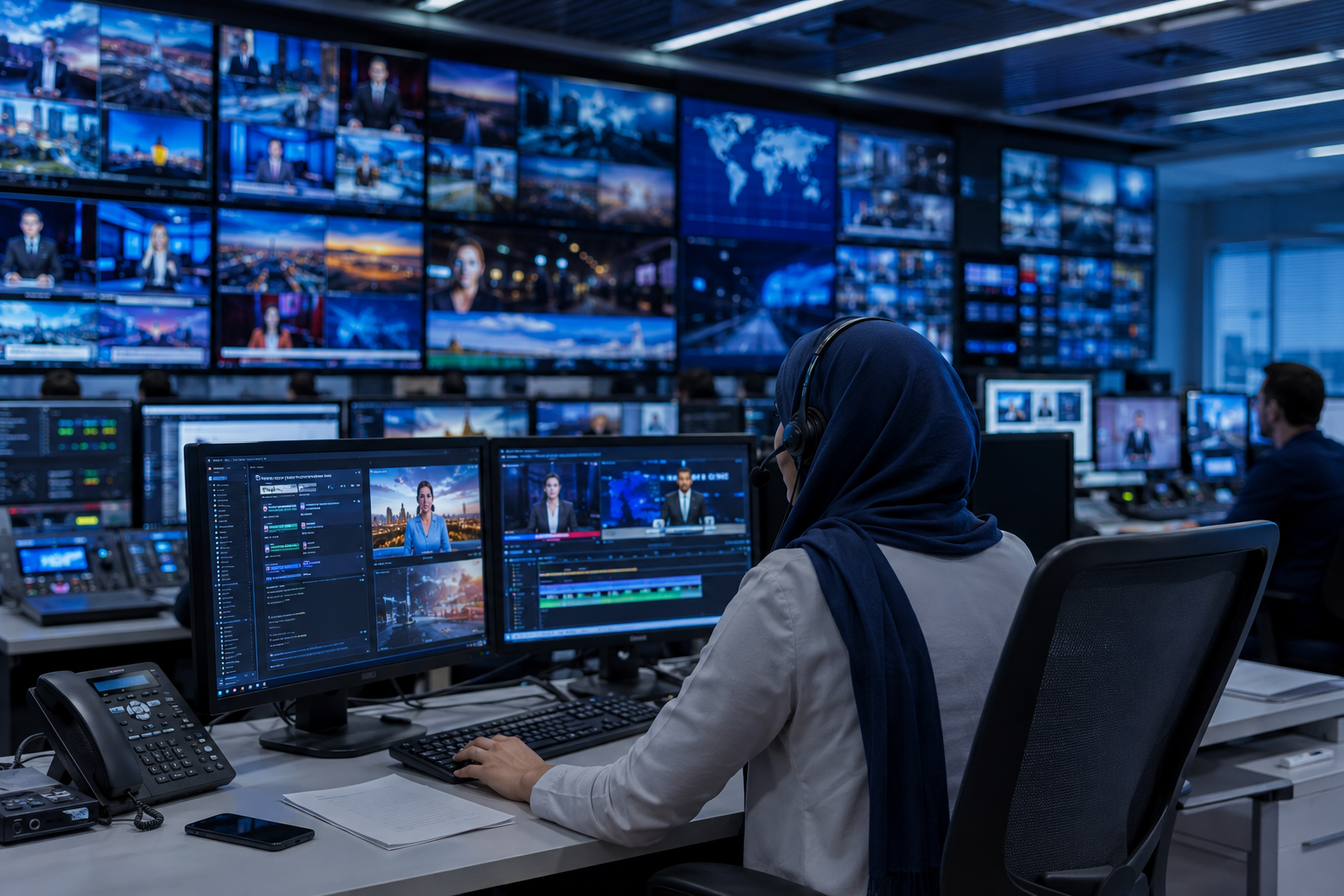
As a rough planning figure, one terabyte of storage can hold around 500 hours of HD television recording. As channel count, recording bitrate, and retention periods increase, the data footprint grows rapidly. If hundreds of channels are recorded continuously, local storage in a single server can quickly become a bottleneck in capacity, scalability, manageability, and service continuity.
This is where Xendure can provide the high-capacity, expandable storage layer alongside LanTV. Xendure’s Distributed architecture allows storage capacity to be spread across multiple nodes and expanded as the archive grows. This approach is particularly well suited to video workloads whose data footprint grows continuously.
Beyond capacity, distributed storage can improve availability, workload distribution, and incremental expansion. In an integrated architecture, LanTV handles video ingest and recording, while Xendure provides the persistent storage layer for the archive. As a result, archive growth does not necessarily mean replacing the recording server with a larger system; storage can be scaled out incrementally.
This model is especially attractive for monitoring centers, news organizations, media archives, and projects with long-term video-retention requirements because the complete workflow—ingest, record, store, retain, and retrieve—can be designed as a single, cohesive architecture.
The Advantage of Integrating LanTV and Xendure Within One Technology Group
A key advantage of this solution is that LanTV and Xendure are both part of the Ideano technology group. When two core components of a solution are designed and delivered by the same technology group, integration can go well beyond simply connecting two products. The solution can be architected from the ground up around their shared requirements.
In a real deployment, details such as video-data transport, file naming and organization, capacity management, storage health monitoring, retention policies, and data recovery matter enormously. Shared technical expertise across both products makes it possible to address these concerns at the solution-architecture level instead of discovering them as integration problems after procurement and deployment.
Deeper integration can also streamline troubleshooting and support. When recording and storage are supplied by different vendors, isolating whether an issue originates in the video source, recording software, network, or storage platform can take time. With an integrated solution, ownership boundaries, monitoring points, and support workflows can be defined and coordinated from the start.
This advantage becomes even more important in large deployments with high channel counts and massive archives. In these environments, hardware selection is only part of the challenge. The way system components interact, how future capacity is sized, and how the platform scales without service disruption are equally critical.
Recommended Architecture for Large Deployments and Long-Term Archives
In a recommended architecture, multiple LanTV systems can handle TV signal ingest and distribution. The recording service captures the required streams and writes the video data to the Xendure storage infrastructure. Xendure storage nodes provide the required archive capacity, and the storage cluster can be expanded as the data footprint grows.